
When people begin thinking about dentures, they often assume they need to skip their regular dental office and go straight to a specialist. In many cases, that is not necessary. A family dentist who regularly provides denture care can evaluate the gums, remaining teeth, bite, and overall condition of the mouth while also helping you understand which type of denture may fit your needs.
That can be especially helpful when you are not starting with a completely blank slate. You may have a few strong teeth, one loose tooth, an older crown, and several spaces that have changed how you chew. Denture planning needs to account for all of those pieces, not only the teeth that are already missing.
At Overland Park Family Dental in Overland Park, KS, Dr. Creighton Gallagher provides full dentures, partial dentures, and implant-supported options. He is skilled in restorative care and continues expanding that knowledge through advanced dental education. For many patients, receiving dentures through a familiar family dental office makes the process easier to understand and far more convenient to manage.
Reason One: You Can Receive Denture Care at Your Dental Home
There is a practical advantage to working with the dentist who already knows your mouth. Dr. Gallagher may have years of X-rays, exam notes, and treatment history showing which teeth have stayed stable and which ones have gradually changed. That background gives him useful context before the denture plan begins.
You may not remember which molar has the older filling or when a crown was placed. You may only know that chewing on the left side has become less comfortable lately. Because Dr. Gallagher can compare your current concerns with earlier records, he can see how the mouth has changed over time.
The office is familiar too. You know where to park, whom to call, and what to expect when you arrive. That may sound like a small detail, but it becomes more valuable when treatment involves several visits and more than one part of the mouth needs attention.
Dr. Gallagher can also guide the process from the first exam through any needed preparation, impressions, delivery, and adjustments. If a tooth needs a filling, crown, or extraction first, that care can be included in the same plan. You are not left moving between unrelated offices while trying to keep track of who is handling each step.
That continuity remains useful after the denture is delivered. When a sore area develops or the appliance begins feeling loose, you already have an office that knows how the treatment started. You can bring the denture back, explain what has changed, and have the mouth and appliance checked together.
Reason Two: Dr. Gallagher Can Help Decide Which Teeth Are Worth Keeping
Many patients who ask about dentures still have natural teeth in place. One of the biggest decisions is whether those teeth are healthy enough to keep and whether they can support a partial denture. That choice affects stability, appearance, cost, and how much treatment may be needed later.
A strong natural tooth can provide valuable support for a partial. It may help the appliance feel steadier during meals and reduce movement while speaking. Keeping useful teeth can also preserve more of the natural bite.
However, not every remaining tooth is dependable enough to build around. A tooth with severe decay, a deep fracture, advanced gum disease, or significant movement may create trouble soon after the partial is completed. In that case, removing the tooth first may lead to a more practical design.
This is where your dental history becomes helpful. Dr. Gallagher can compare current X-rays and findings with earlier visits to see whether the bone and gum support have stayed steady. An older crown may still be serving the tooth well, while another tooth may have reached the point where another repair would not provide enough support.
That does not mean every questionable tooth automatically needs to come out. Instead, Dr. Gallagher looks at what each tooth can realistically contribute. Some may be kept, some may need treatment, and others may be better removed before the denture is made.
For patients, that makes the plan easier to understand. You can see why a tooth is being kept, repaired, or removed and how that decision affects the appliance. The denture is then designed around the teeth and gums that will support it day after day.
Reason Three: You Do Not Have to Decide for Yourself Whether You Need a Specialist
Most patients do not know whether their denture case is routine or unusually complex. It can be difficult to judge how much bone loss affects the plan, whether an old bite problem needs special attention, or when implant treatment requires a more advanced approach. That decision should not depend on comparing a few online photographs and hoping your case looks similar.
Dr. Gallagher is skilled at treating a variety of full and partial denture cases. Many patients can complete their care with him, including preparation, delivery, adjustments, and ongoing maintenance. His continuing education also helps him manage a broad range of restorative concerns.
Some cases do benefit from a prosthodontist. Severe bone loss, repeated trouble with previous dentures, major bite concerns, or advanced implant reconstruction may require more specialized planning. Prosthodontists complete additional training focused on restoring and replacing teeth.
When that expertise would improve the plan, Dr. Gallagher can refer you to one of his prosthodontist colleagues. He can explain why the referral is being made and continue caring for your overall dental health. You are not simply handed a name and left to sort out how the pieces fit together.
That gives you a clear place to begin. Dr. Gallagher can evaluate the mouth, explain the main choices, and decide whether the case can stay with him or would benefit from another level of care. Either way, the first visit moves the process forward.
What Is the Difference Between Full and Partial Dentures?
A full denture replaces every tooth in the upper jaw, lower jaw, or both. It rests directly on the gums and depends on the shape of the jaw, saliva, and surrounding muscles for stability. Since no natural teeth remain underneath, the fit comes from the denture base and the tissues supporting it.
An upper full denture usually covers much of the roof of the mouth. That broader surface can improve suction and often makes the upper appliance feel steadier. At first, the palate coverage may feel unfamiliar, and food texture can seem slightly different while the mouth adjusts.
A lower full denture sits along the jaw ridge and curves around the tongue. It has less surface area available for support, so it often moves more than an upper denture. With time, the tongue and cheek muscles learn how to help keep it in place during meals and speech.
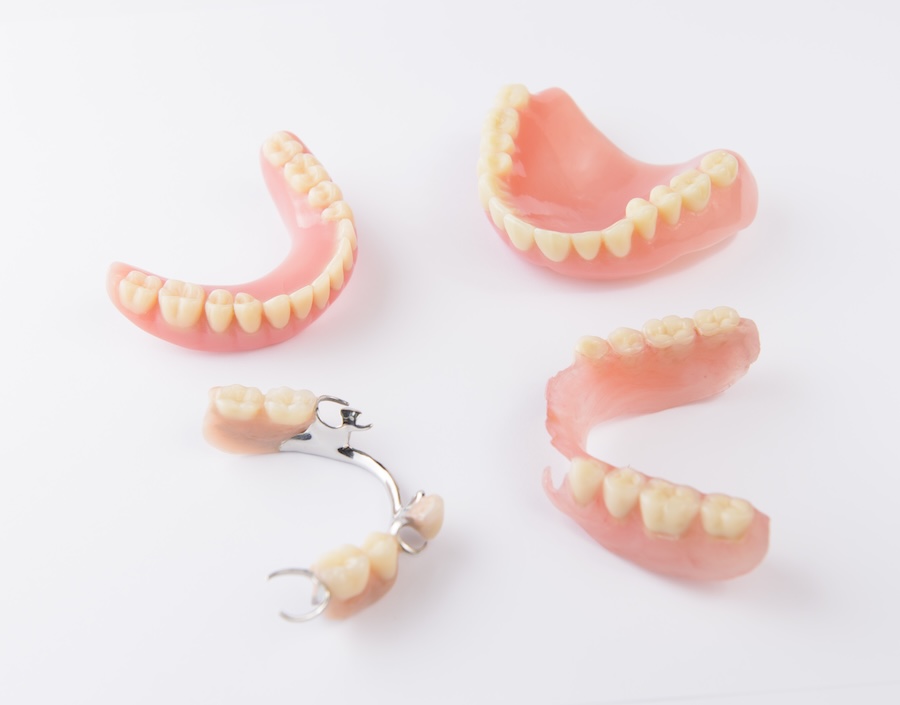
A partial denture fills selected spaces while leaving useful natural teeth in place. It may use clasps, rests, acrylic, a metal framework, or tooth-colored components. Those natural teeth help anchor the appliance and usually provide more stability than the gums could offer alone.
Because the partial depends on those teeth, they need careful cleaning and regular exams. Plaque can collect around clasps and contact points, and decay in one support tooth can affect the entire appliance. The replacement teeth fill the spaces, but the natural teeth are still doing much of the supporting work.
What Do New Dentures Feel Like?
A new denture usually feels larger than expected during the first few days. The tongue notices every edge, saliva may increase, and familiar words can sound slightly off. Those reactions often settle once the mouth becomes used to the new shape.
Full dentures may take more muscle practice because they rest on the gums. A partial often feels steadier, although the framework and clasps can still seem noticeable at first. Neither type should continue rubbing or pinching the same area after adjustments have been made.
The first meals are usually easier with soft foods cut into smaller pieces. Chewing slowly on both sides can help keep the appliance balanced. A thick sandwich on the first afternoon may be a little ambitious while the mouth is still learning where everything sits.
As comfort improves, firmer foods can be added gradually. Sticky foods and small seeds may remain more challenging because they can pull on the denture or slip underneath it. Most patients eventually find a routine that works well for them.
Speech usually improves with use too. Reading aloud at home can help the tongue learn the new surfaces. However, if clicking continues or certain sounds remain difficult, Dr. Gallagher may need to adjust the bite or tooth position.
How Denture Materials Affect Comfort
Full dentures are commonly made with an acrylic base that resembles the gums. The replacement teeth may also be acrylic or another durable dental material. Acrylic can be shaped, adjusted, and repaired when needed.
Partial dentures may use acrylic, cast metal, flexible material, or a combination. Acrylic partials tend to be thicker and may work well as temporary or lower-cost appliances. Cast-metal partials can often be made thinner and may feel less bulky.
Flexible partials can reduce visible metal in certain areas, but they do not suit every bite or pattern of missing teeth. They may also be harder to adjust or repair. A material that looks appealing in a sample may not provide the support a particular mouth needs.
Dr. Gallagher can explain how each option affects fit, strength, cleaning, and future repairs. That helps move the decision beyond appearance alone. The denture still has to make it through breakfast, conversation, and dinner without constantly demanding attention.
Dentures Still Need Regular Dental Visits
Even when no natural teeth remain, the mouth still changes over time. The gums and jawbone can gradually reshape, which may affect how the denture sits. A fit that felt secure several years ago may start shifting during meals or rubbing one spot repeatedly.
Regular visits give Dr. Gallagher a chance to examine the gums, check the bite, and look for worn areas on the appliance. For patients with partial dentures, those appointments also help protect the natural teeth supporting the appliance. A small cavity near a clasp can become a much bigger issue when it is allowed to grow unnoticed.
These visits are also a good time to mention changes that are easy to dismiss at home. Perhaps the lower denture lifts whenever you laugh, or food has started finding the same hiding place after every meal. Those details help Dr. Gallagher understand how the appliance is working outside the treatment room.
Dentures at Overland Park Family Dental
Receiving dentures from your family dentist can make the process feel more familiar and easier to coordinate. Dr. Gallagher already understands your dental history, can evaluate which teeth may still support a partial, and can determine whether your case can be handled in the office or would benefit from a prosthodontist. Those are practical benefits that affect the choices you make and the care you receive.
At Overland Park Family Dental in Overland Park, KS, Dr. Creighton Gallagher provides full dentures, partial dentures, and implant-supported options. He can guide the process from the first exam through preparation, delivery, and future adjustments. When a case calls for more advanced treatment, he can coordinate care with one of his prosthodontist colleagues.
Schedule a visit when missing teeth, a loose denture, or a worn partial is making meals or speech more difficult. Bring your current appliance if you have one, even when it has been spending most of its time in the case. Dr. Gallagher can examine the fit, explain the available choices, and help you move toward a denture that feels comfortable and practical for everyday life.